

Australian Family Visas
Family visas are designed for individuals who wish to bring their partner, children, or parents to Australia from overseas.
At Wings International, we’ve been helping reunite families in Australia for over 10 years. Whether you're applying from within Australia or offshore, our experienced migration team can guide you through the process with care and clarity.
We provide assistance with partner, child, parent, and other family visa pathways — ensuring each step is clearly outlined and fully supported.


Partner Visa
Partner visas allow the spouse or de facto partner of an Australian citizen, permanent resident, or eligible New Zealand citizen to live in Australia, offering a clear pathway to permanent residency.
For applicants within Australia, the two main options are:
Partner (Temporary) Visa (subclass 820)
Partner (Permanent) Visa (subclass 801)
For applicants outside Australia, the relevant options include:
Partner (Provisional) Visa (subclass 309)
Partner (Migrant) Visa (subclass 100)
The Prospective Marriage Visa (subclass 300) — also known as the fiancé visa — allows an individual to enter Australia to marry their prospective spouse, after which they can apply for a Partner visa onshore.
To be eligible for a Partner visa, applicants must demonstrate that they are in a genuine and continuing relationship. Supporting documentation is required to validate the relationship, along with meeting health and character requirements.


Child Visa
Child visas are designed for children whose parents reside in Australia. There are two main subclasses available:
Subclass 101: Allows a child living outside Australia to move and live with their parents in Australia.
Subclass 802: Enables a child who is already in Australia to remain permanently with their parents.
To be eligible for a child visa, applicants must:
Be a dependent child of a parent who is an Australian citizen, permanent resident, or eligible citizen.
Be single.
Be under 18 years of age, or a full-time student under 25 years old.
Be financially dependent on their parent.

Parent Visa
Parent visas are available to parents of Australian citizens, permanent residents, or eligible New Zealand citizens. There are various parent visa options that allow individuals to either visit their children in Australia temporarily or move permanently.
To be eligible for a parent visa, applicants must:
Be sponsored by their child or eligible sponsor in Australia.
Meet the balance of family test, unless an exemption applies.
The balance of family test requires that applicants have at least half of their children residing in Australia.
Other Family Visas
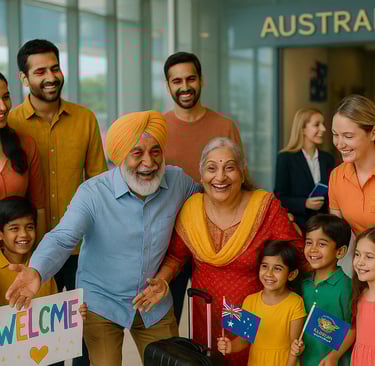
Family situations can be diverse, and not all are covered by the main family visa categories. Other family visas—such as carer visas, remaining relative visas, orphan relative visas, and adoption visas—ensure that a wide range of family circumstances are recognized, providing opportunities for reunification.
Carer visas are available to individuals who are willing to travel to and live in Australia to provide care for a relative with a long-term medical condition who does not have reasonable care options within Australia. The person needing care must be an Australian citizen, permanent resident, or eligible New Zealand citizen.
Remaining Relative Visa
The remaining relative visa is for individuals who do not have any close family members elsewhere, except for relatives living in Australia who are Australian citizens, permanent residents, or eligible New Zealand citizens.
Orphan Relative Visa
The orphan relative visa allows a single child to come to Australia to live with a relative when their parents are deceased, unable to care for them, or cannot be located. The relative must be an Australian citizen, permanent resident, or eligible New Zealand citizen.
Adoption Visa
The adoption visa permits children adopted outside Australia to live in Australia with their adoptive parent. The adoptive or prospective adoptive parent must be an Australian citizen, eligible citizen, or hold an Australian permanent visa.

Assistance
Expert support for your immigration journey ahead.
Clarity
Trust Your wings
support@wings-international.in info@wings-international.in, advice@wings-international.in
+91 9814-01-8729
© Wings International 2025. All rights reserved.
Disclaimer: The content provided on this website is for general informational and educational purposes only and does not constitute personal migration advice. Users are strongly advised not to act solely on the basis of material contained herein. For guidance specific to your circumstances, we recommend consulting directly with a licensed migration professional, who operates in accordance with all applicable codes of conduct and professional standards. By continuing to use this site, you acknowledge and accept that Wings International holds no liability for any actions taken based on website content alone.


+61 4813-01-630


Wings International is not a recruitment or placement agency. We do not offer, promise, or facilitate any form of employment—either domestically or internationally. Our assistance strictly excludes job guarantees, employment arrangements, or any form of recruitment services. Any assumptions or expectations of job placement based on our assistance are unfounded and solely at the risk of the individual.
“Wings International is a private and independent entity that provides assistance with visa-related procedures based solely on publicly accessible information and official resources. Our approach is grounded in transparency, professional competence, and a consistent commitment to responsible, high-quality support. We affirm that Wings International is neither affiliated with nor endorsed by any government authority or immigration department. Additionally, we do not operate any branches, offices, or have authorized representatives in any location other than our officially designated office.”
SCO-54-55-56, Forth Floor, Sector-17A, Chandigarh-160017- Available only on appointment at this location.
Any visa category mentioned on this website is provided strictly for informational purposes only. Wings International does not engage in any immigration, migration, or consultancy-related assistance for such categories. Users are advised to exercise their own discretion and judgment before relying on or acting upon any such information.